eValueMaxAI™
Enterprise-Grade AI. Powering Your Vision to Scale your Business
Beyond the AI Fear Psychosis: Why its neither AI will replace you nor those using AI wil, reality is more nuanced

by | Sep 14, 2026 | Uncategorized | 0 comments

False Dilemma

The technology landscape is currently caught in a false dilemma.

On one side lies the apocalyptic fear psychosis: algorithms will wake up, automate human intellect into obsolescence, and trigger economic collapse. On the other lies the corporate platitude: “AI won’t replace you, but someone using AI will.”

Both miss how physical businesses operate. The first mistakes statistical token prediction for autonomous intent. The second treats the human as a passive button-pusher.

True enterprise transformation is not about replacing people or decorating legacy ERP systems with conversational chatbots. It is about deploying deterministic computational engines to expand total factor productivity, enabling enterprises and developing economies to scale beyond historical constraints.
he Industrial Reality Check: Why Attention Models Fail Continuous System

Marketing narratives eagerly claim total computational autonomy when an outcome succeeds, but swiftly deflect blame to “data pipelines” the moment real-world systems fail.

This tension is familiar to industrial veterans. Over two decades ago, the Nike and i2 Technologies software failure cost over a hundred million dollars in inventory write-downs because ungrounded predictive algorithms misread baseline demand signals and lacked physical feasibility checks.

Today, organizations risk repeating this exact disaster on a vastly larger scale by mistaking Large Language Models (LLMs) and attention mechanisms for supply chain engines.

Consider a continuous chemical and synthetic textile chain:

  • Stoichiometric Balance: Purified Terephthalic Acid (PTA) reacts with Monoethylene Glycol (MEG) in continuous polymerization reactors under strict proportions.

  • The Cascading Trap: If an unconstrained attention model hallucinates a demand shift and misallocates upstream PTA inventories, you do not just face a minor warehouse stockout.

  • Capital Destruction: A sudden shortage of PTA forces a continuous chemical line to crash. Molten polyester freezes inside piping and reactors, causing weeks of mechanical downtime, millions in capital destruction, defective yarn spinning downstream, and idle looms across weaving mills.

Attention algorithms correlate tokens in high-dimensional semantic spaces; they do not know the laws of chemistry, plant engineering, or mass balance.

The Architecture: Where Optimization Meets Discretion

To achieve genuine scale, an enterprise cannot rely on a single, monolithic model. It requires a tiered architecture that pairs probabilistic insights with deterministic mathematical optimization:

Layer Computational Engine Operational Domain Irreplaceable Human Edge
Synthesis & Velocity Generative AI & LLMs CRM pattern mining, unstructured document ingestion, client communication. Empathy & Subtext: Reading between the lines during high-stakes B2B negotiations and detecting strategic bluffs.
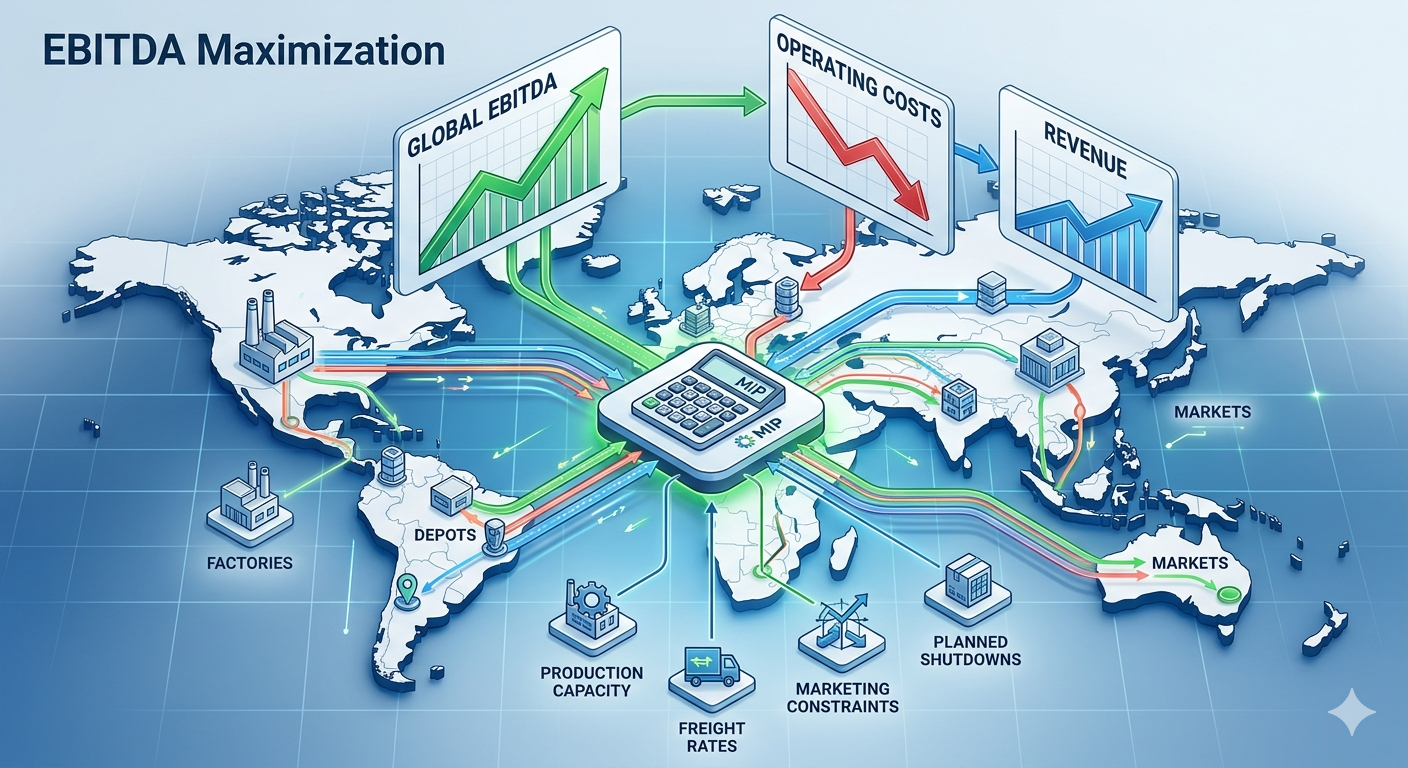
Physical Feasibility Mixed Integer Programming (MIP) ERP scheduling, multi-echelon SCM routing, continuous line mass balance, discrete bounds. Boundary Setting: Deciding when an enterprise must deliberately violate a short-term mathematical bound to preserve a strategic partnership.
Strategic Governance Human Reason & Intuition Corporate capital allocation, macroeconomic positioning, cross-border geopolitical risk. Accountability: Owning moral, financial, and fiduciary consequences that no mathematical loss function

Just as AlphaZero relies on Monte Carlo Tree Search (MCTS) to prune decision trees within strict rules rather than generating open-ended text, modern ERP and SCM systems depend on Mixed Integer Programming (MIP). MIP guarantees mathematically proven feasibility, acting as the deterministic guardrail that prevents algorithmic hallucinations from rupturing the physical supply chain.

The Macro View: Productivity, Redeployment, and Enterprise Scale

The fear that productivity gains lead inevitably to mass unemployment ignores basic economic history.

When mechanization transformed agricultural and textile production, human labor was not permanently retired—it was redeployed. Lower production costs ignited unprecedented consumer demand, spawning modern industries in distribution, engineering, chemical synthesis, and global retail.

Today, over two-thirds of the world’s population lives below the $14,000+ per-capita income threshold defining developed nations. The global challenge is not a surplus of human labor; it is an acute deficit of industrial productivity, logistics infrastructure, and operational efficiency.

When AI optimizes a multi-echelon supply network or eliminates administrative drag in ERP, the primary outcome is not head-count reduction. It is enterprise scale. A regional manufacturer can coordinate ten times the output, service broader international markets, and deploy its workforce toward strategic vendor relations, product innovation, and customer engagemen

The Final Verdict
  1. AI is not an autonomous replacement for human capability.
  2. Generative models provide conversational and synthesis velocity. Mixed Integer Programming enforces physical and mathematical discipline. But the ultimate differentiator—the spark that steers capital, spots unseen risks, and invents new business models—remains individual human intuition and seasoned reasoning.
  3. At eValueMaxAI, we don’t build tools to replace the decision-maker. We engineer the mathematical and algorithmic engines that empower them to scale their enterprises without limit

0 Comments

Submit a Comment

Your email address will not be published. Required fields are marked *

Written by Girish Kamat

Related Posts

The Moral Economics of Entrepreneurship

Entrepreneurship — not labour alone, nor capital alone — is the true engine of wealth creation. Labour provides effort; capital provides means. But neither can transform ideas into value without the spark of enterprise. It is the entrepreneur who combines risk,...

read more

0 Comments

Submit a Comment

Your email address will not be published. Required fields are marked *