
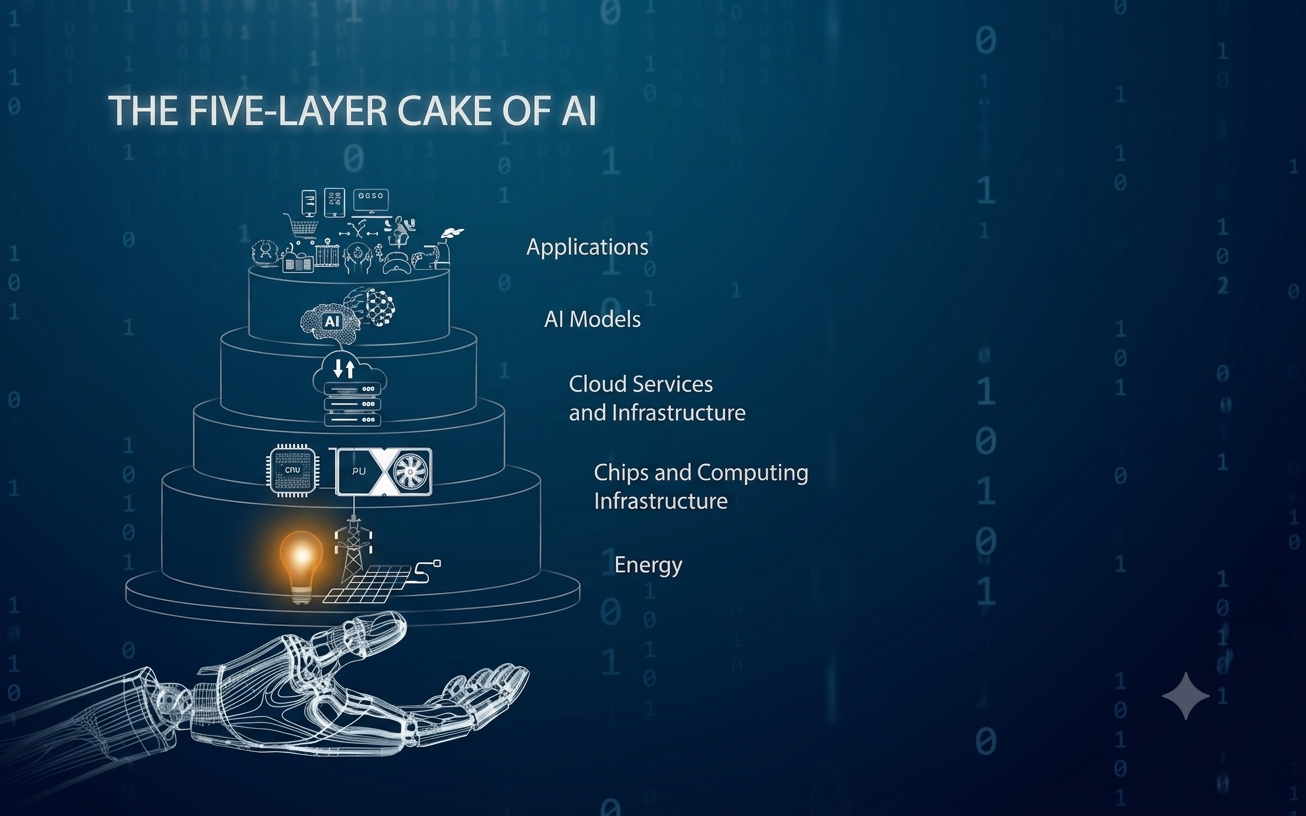

Five Layers of AI
NVIDIA’s Jensen Huang recently framed the global artificial intelligence economy as a “five-layer cake”:
-
Energy (Round-the-clock baseload power)
-
Chips (Silicon matrix multipliers)
-
Infrastructure (Liquid-cooled hyperscale data centers / “AI Factories”)
-
Models (Domain brains and reasoning systems)
-
Applications (Real-world workflow integration and economic value)
The prevailing narrative—amplified by Wall Street earnings calls, hardware vendors, and Silicon Valley labs—insists that nations must pour tens of billions of dollars into Layers 1, 2, and 3 or face permanent technological irrelevance by 2030.
This is an artificial urgency. For India, chasing the bottom three layers of this stack is a dangerous capital trap. India’s strategic, sovereign, and economic advantage lies in deliberately bypassing the hardware hype and anchoring its future in Layer 4 (Domain Models & Mathematical AI) and Layer 5 (Applied Operations).
The Flaw of Infrastructure FOMO (Layers 1 to 3)
1. The 24/7 Energy Reality
An AI factory is an unyielding, 99% capacity-factor power sink. Solar power alone cannot run it; solar operates at a ~20–24% capacity factor in India, and battery storage triples the levelized cost of electricity. Every scarce gigawatt of firm baseload power diverted to chill GPU racks is a gigawatt pulled away from the productive industrial manufacturing lines India needs to build its economic foundation.
2. The Silicon Depreciation Trap
Semiconductors operate on a brutal capital cycle. Historically, legendary foundries scaled during cyclical downturns when equipment was cheap—not at peak bubble valuations. Today’s high-end GPUs carry massive historical baggage (graphics silicon, warp schedulers) and face steep capital obsolescence within 36 months. Subsidizing legacy 28nm+ mature fabs with public billions does not yield AI silicon; it simply produces low-margin commodity microcontrollers in an already saturated global market.
3. The Modern Mainframe Fallacy
Today’s centralized GPU data center is the modern equivalent of a 1970s IBM timesharing mainframe. The true software explosion occurred only when computing decentralized from water-cooled corporate basements to personal computers. Pumping national balance sheets into centralized GPU server farms mistakes an inefficient intermediate architectural phase for the permanent destination.
The Kepler vs. Newton Trap
Much of today’s AGI panic confuses empirical curve-fitting with true mechanical understanding.
In 1609, Johannes Kepler calculated accurate mathematical curves to predict planetary orbits from Tycho Brahe’s raw observations. But it took 78 years—until Isaac Newton published the Principia in 1687—to invent the calculus and uncover the causal physics of universal gravitation.
Modern Large Language Models are in their Keplerian phase: extraordinarily capable statistical pattern interpolators that fit high-dimensional curves over human text. Scaling them with 100x more compute does not spontaneously yield physical causality. Rushing to burn national reserves on brute-force hardware before the underlying mathematical paradigm shifts is buying Brahe’s observatories right before the telescope is invented.
The Strategic High Ground: Owning Layers 4 and 5
While hardware depreciates and foundries face obsolescence, mathematical formulation and operational domain logic never decay.
-
Escaping the “IT Reseller” Box: The traditional IT services approach—licensing foreign proprietary models, training thousands of engineers on someone else’s API, and billing low-margin integration hours—is an economic dead end. When the API provider updates its model, it absorbs the application layer beneath it.
-
Hybrid Layer 4 Ownership: True enterprise AI is not pure next-token prediction. Demand planning, supply chain logistics, grid balancing, and operations research require neuro-symbolic systems: neural networks for feature extraction paired with deterministic mathematical optimization (MILP, stochastic solvers). These models are lean, measure in the billions of parameters rather than trillions, and execute on cheap, standard enterprise CPUs or open RISC-V architectures.
-
Layer 5 as the Sovereign Moat: Real economic value belongs to the entity that controls the physical execution loop. By deploying domain-specific intelligence directly into India’s complex logistics corridors, agriculture, cold chains, and public digital rails, domestic enterprises capture high-margin software value that foreign models cannot replicate.
Capital Discipline Over Panic
When Europe succumbed to spectrum FOMO during the 3G auctions of 2000, its telcos burned over $100 billion, saddled themselves with crushing debt, and froze capital expenditures for a decade—only for American application platforms (Layer 5) to capture virtually all the economic profit.
India cannot afford to repeat that cycle in hardware. In a country working through basic nutrition and supply chain waste—where post-harvest perishables suffer ~30% spoilage—public capital belongs in physical infrastructure, cold chains, and manufacturing plants.
Let global hyperscalers absorb the massive depreciation bills of the early hardware race. India’s path to enduring technological sovereignty is clear: leave the foundries and power plants to global commodity markets, and own the mathematical models and vertical applications that run the real economy.
For a direct look at the original framing, Jensen Huang breaks down the underlying framework in

0 Comments